

I knew, theoretically, what I was signing up for when I left my job to start Compute Gardener. I'd read the articles, heard the war stories, nodded along to the podcast interviews where founders talked about the emotional rollercoaster. I understood the statistics. I knew most startups fail.
But here's the thing about theoretical knowledge: it lives in your head, where it can't really hurt you, at least not emotionally. The possibility seems safe enough at first consideration. Comfortable, even. You can sit in a company cafeteria, sipping free coffee, thinking about all that flexibility and upside, and the theoretical risks feel... manageable. Abstract. Like something that happens to other people.
Months into this journey, I'm constantly being reminded that imagining these realities is a completely different beast than experiencing them.
So this post is my attempt to put some of those feelings into words; not because I have answers, but because I suspect I'm not alone in being surprised by how these things actually hit.
The "Right Thing" Trap
Every morning, I face a version of the same question: Am I doing the right thing today?
Not in a moral or philosophical sense. But in a brutally practical one: Should I be writing code or should I be reaching out to potential users? Should I refine the product or should I be building community? Should I dig into that technical problem I find fascinating or should I force myself to do the marketing work that makes my skin crawl?
The trap is this: I can easily convince myself that what I want to be doing is what I should be doing. I'm technical. I love solving technical problems. It feels productive. It feels like progress. And maybe it is! Or maybe I'm just hiding in my comfort zone while the things that actually matter (the uncomfortable work of putting myself out there, of building relationships, of doing marketing as a decidedly non-marketing person) languish on my todo list.
Am I sure I'm laying the groundwork for innovative projects to come or am I simply yak shaving our lab setup? Am I REALLY sure about that?
Before venturing out, I knew these things would be challenging. It turns out they're challenging not because the tasks themselves are insurmountable, but instead because every single day you have to choose discomfort over comfort, uncertainty over certainty, vulnerability over control. You have to do the things you're worst at first, the things that feel awkward and forced, knowing full well it might not even matter.
And here's what makes it worse: you're never quite sure you're making the right call. Maybe the technical work is the priority right now. Maybe I am overthinking the marketing stuff. Maybe, maybe, maybe.
The theoretical knowledge that "founders need to do uncomfortable things" does not prepare you for the daily, grinding reality of doing them anyway while second-guessing yourself the entire damn time.
The Impact Paradox
Let's talk about the math that doesn't quite add up, the calculation we all make when we decide to start something.
At a large company, there's a floor and a ceiling on your impact. You're probably not going to directly change the world from inside Google or Microsoft, but you're also not going to have zero impact. You'll ship features, help colleagues, contribute to products that reach millions of people. The impact is real, if bounded.
But that's not why we become entrepreneurs. We do it because we want to break through that ceiling. We want the upside: the possibility of having massive impact, of building something that genuinely changes how people work, of seeing our ideas actually matter in the world.
Of course, in reaching for that possibility, we've also removed the floor.
The most likely outcome of any startup isn't moderate success or even graceful failure. It's zero impact. Or close to it. You can pour years of your life into something, do everything "right," and still end up with a product nobody uses, a blog nobody reads, a company nobody's paying.
I knew this, statistically, before I started. Startups fail. Most ideas don't find product-market fit. That's just how it works. What I didn't fully appreciate was how this knowledge would feel in the middle of the journey. When you're months in, when you're questioning whether you've even identified the right metrics to track progress, when you're not sure if you're making traction or just moving in circles, the possibility of zero impact stops being a statistic and starts being a weight you carry.
The irony is that entrepreneurs are precisely the people drawn to situations where they can amplify their impact. We want the leverage and the possibility of outsized returns on our effort. But that same leverage cuts both ways. The structure that lets you 100x your impact also allows you to 0x it.
And we go in with eyes open! We tell ourselves we understand the risks. We probably even believe it.
But sitting in that Google cafeteria, contemplating the leap, imagining the freedom and flexibility and potential... I don't think I really felt what it would be like to worry that all of this might amount to nothing. That the conversations I'm having, the code I'm writing, the posts I'm publishing; all of it might just be noise that nobody hears.
Of course, there are silver linings. Learnings. Connections. Skills developed. These aren't nothing. But they also aren't the goal. The goal is impact. The goal is building something that matters.
"But It Might Work for Us"
There's an old Arrested Development bit where Tobias and Lindsay are talking about having an open relationship. They acknowledge that such relationships never work for anyone, people are only deluded into thinking they will. And then Tobias says, cheerfully: "But it might work for us."
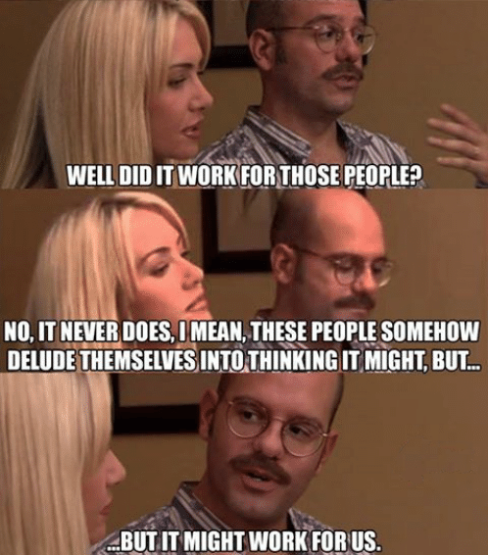
I know I often feel like Tobias. And if you're the kind of person considering starting something, or in the middle of your own journey, you're probably thinking: "Sure, but this doesn't apply to me." You're different. Your idea is different. You'll do the uncomfortable work. You won't fall into the traps.
And you know what? Maybe you're right! Of course, many entrepreneurs do succeed. The statistics don't apply equally to everyone. Maybe you are the exception. I really hope you are.
But here's my warning, delivered with as much vulnerability and hard-earned wisdom as I can muster while maintaining some professional credibility: you probably won't believe you're in the trap until you're already caught in it. You may not realize you've been hiding in comfortable technical work until months have passed. You likely won't feel the weight of potential zero-impact until you realize it's already around your neck.
I'm not writing this to discourage you. Honestly, I don't believe anything I write could discourage the kind of person who I'm writing this for. If you're built for it, you're going to do it anyway, warnings be damned.
I'm saying it because maybe, just maybe, having someone mention these feelings makes them slightly less isolating when (not if) you encounter them. Maybe knowing that the gap between theoretical understanding and lived experience is shared by others makes the surprise of it sting a tiny bit little less.
Where I Am Now
I'm still figuring this out. I don't have a neat conclusion or a five-point action plan. I'm not always sure I'm doing the right things on any given day. I don't know if Compute Gardener will gain the traction it needs to survive, let alone thrive. I don't know if I'm measuring the right metrics or if I'm even asking myself the right questions.
What I am doing is sitting in the discomfort. Doing the marketing work even though it feels painfully awkward. Building in public even though it's vulnerable. Writing posts like this one even though it would be easier to just stick to technical content.
And I'm trying to remember that the people who succeed at this aren't the ones who avoid these feelings. They're the ones who feel them and keep going anyway.
If you're in this with me, whether you're months ahead or months behind: I see you. This is harder than they told us. But even if we heard the warnings, we know we were probably going to do it anyway.
Because despite everything I've written here, despite the uncertainty and the discomfort and the very real possibility that this might not work out... I still think it just might work for us!
Compute Gardener is a project aimed at simplifying carbon-aware computing in Kubernetes. If you want to follow along with this journey; the technical wins, the strategic pivots, the occasional existential crisis... you can find details about the project on our website, github repo or reach out directly (dave@elevated-systems.com). I'm always happy to compare notes with fellow founders, especially over coffee. The kind we pay for ourselves now.